
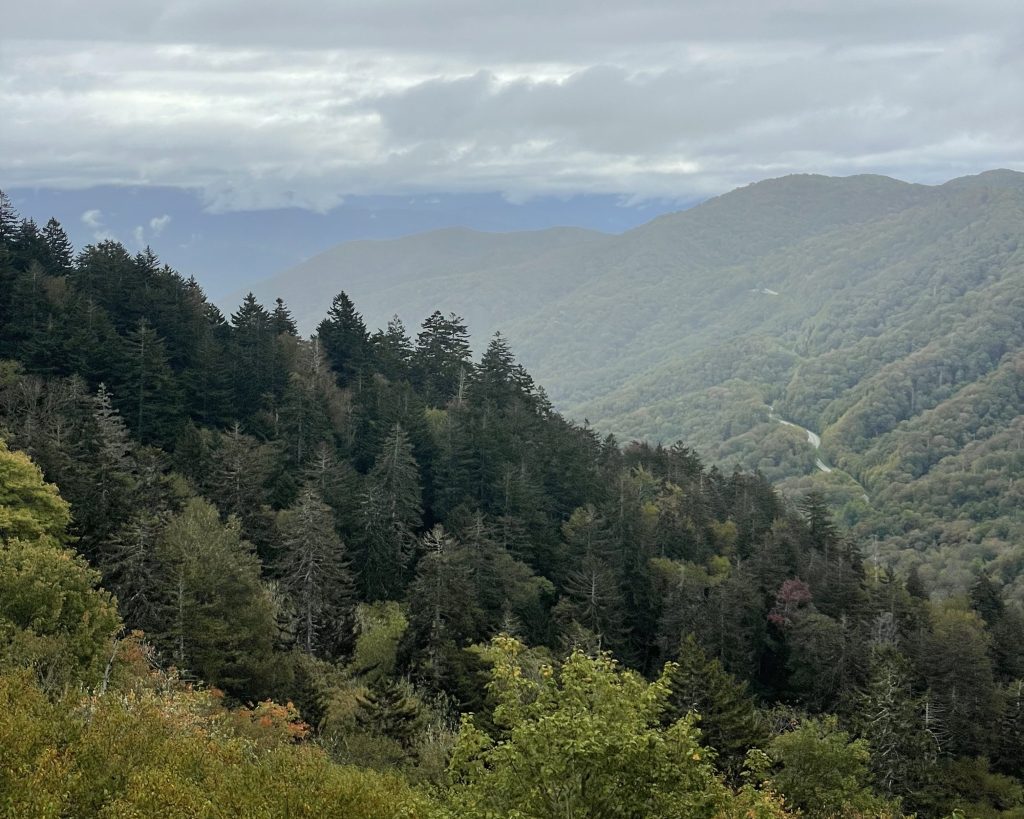
What to prioritize with only one day to explore this park that straddles North Carolina and Tennessee
At the end of September, my husband and I took a few days off work to celebrate our first wedding anniversary. We drove down the Blue Ridge Parkway, our destination being Cherokee, North Carolina, which we’d use as a home base to explore Great Smoky Mountains National Park.

We live in Washington, DC (at the time of this writing), and have explored Shenandoah pretty heavily, so I was very excited to see a more southern section of Appalachia with its higher elevations and unique ecosystems.
While I’m an avid hiker, my husband prefers to enjoy nature from viewpoints and road trips, so we approached the Smokies with a compromise: we’d do a lot of scenic driving in the area, while spending one day in the park alternating between short hikes and awesome viewpoints – plenty for both of us to enjoy!
Below, find a guide to how we spent our day.
Breakfast in Cherokee, North Carolina
We started our day by grabbing breakfast in Cherokee on our way in to the park area. It’s important to us to support Indigenous businesses while we’re exploring their ancestral lands, so we made a point to buy from Front Porch Cakery & Deli.
First Stop: Oconaluftee Visitor Center


Upon entering the park, we made a stop at the Oconaluftee Visitor Center, where you can pick up a trail map and secure your parking pass before venturing further into the park. There is also a lot of great information about the natural and cultural history of the park area.
Note: Great Smoky Mountains National Park approaches fees and parking differently than other national parks (as of this writing, in November 2025). Instead of charging an entry fee, the park only charges a small fee for a parking pass, which allows you to stop anywhere inside the park, like at viewpoints and trailheads. If you’re just driving through, you can do so without purchasing a parking pass.
Park passes that secure your entry into other national parks year-round (like the America the Beautiful pass) do not apply at GSMNP.
Next Stop: Newfound Gap Overlook

From the visitor center, we continued further into the park along Newfound Gap Road, which rose in elevation until we were literally in the clouds, at around 5,000 feet. At this elevation, you’ll find trees that typically grow in climates much farther north, like fraser fir and red spruce. The vegetation is a dramatic change from Appalachia’s lower elevations where deciduous (non evergreen) trees reign supreme.
We arrived at Newfound Gap Overlook amid fog and mist, which hugged the trees and ridgelines in every direction. Fall was just beginning, and newly yellow leaves floated all around us. It was a truly magical vista point.
That said, it’s one of the most popular areas of the park, so it was very crowded with large tour buses and groups (even on a weekday!). Don’t expect solitude here.
Kuwohi Summit (formerly known as Clingman’s Dome)


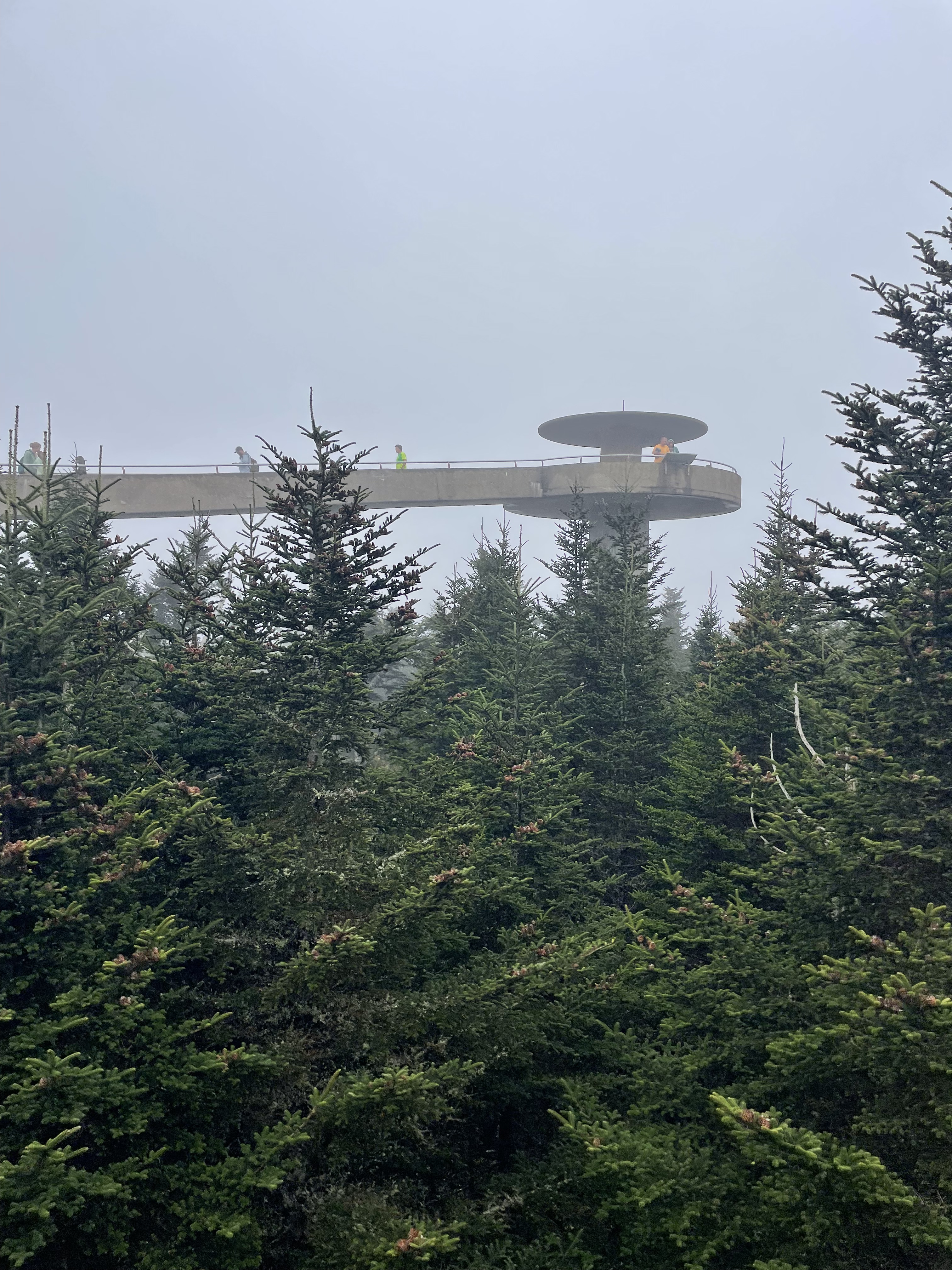
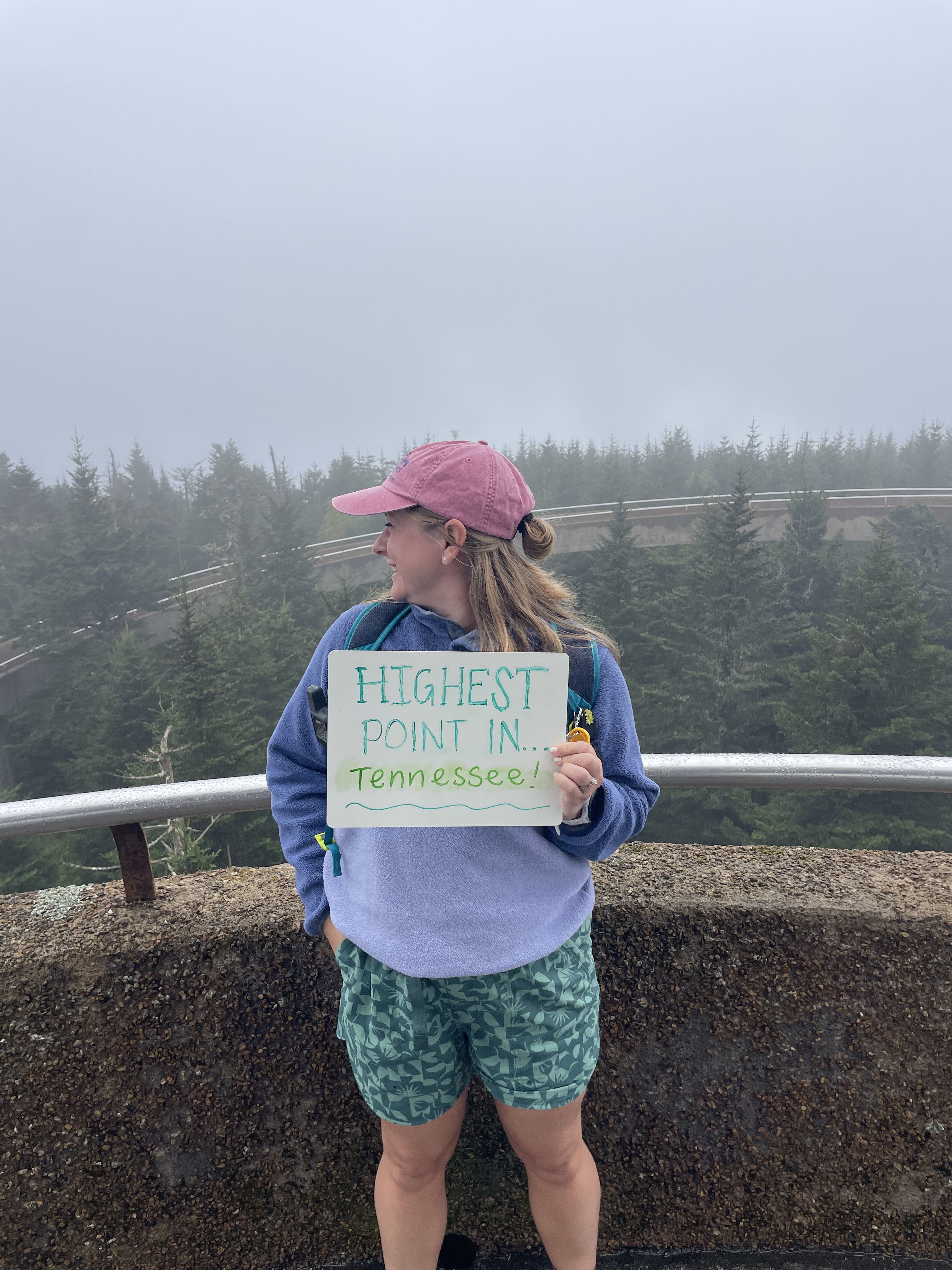
The pinnacle of our day was our jaunt to the very top of Kuwohi – the highest point in the park at 6,640 feet. Kuwohi sits right at the border of North Carolina and Tennessee, making it the highest point in the state of Tennessee (North Carolina’s high point, Mount Mitchell, sits outside of the park).
Is it called Kuwohi, or Clingman’s Dome?
You might have heard of this mountain referred to as Clingman’s Dome in the past, which is the name that European/American Settlers gave it when they arrived. However, in partnership with the local Indigenous Cherokee people, the National Park Service recently restored the mountain’s official name to Kuwohi, the name it was called for thousands of years before settlers arrived.
Kuwohi Summit Trail
There is a large parking lot at Kuwohi, which leads to a half mile walking path that takes you to the summit, and includes a viewing platform that is elevated above the actual mountain. The path is paved, but quite steep, and definitely a cardio workout.
At this elevation, the entire area was engulfed in a cloud, which means that we did not experience the far-off vistas you might expect from a state high point. While that might be a bummer, I loved this trail anyway, because it’s hugged in every direction by thousands of spruce and fir trees. As the fog pushes through them, the air takes on the misty aroma of a Christmas tree – and this is what you breathe as you ascend to the top. It was incredible.
I’ll just have to go back on a clear day for the long distance views!
Smokemont Nature Trail


After descending from Kuwohi, we made a stop at Smokemont campground, which is found along Newfound Gap road. There, we walked part of the short but beautiful Smokemont Nature Trail – a perfect easy walk that gave me the nature exposure I wanted but wasn’t too taxing for my non-hiker husband.
Bonus Stop: Elk Sighting Near Oconaluftee Visitor Center

On our way out of the park, we noticed a lot of cars around us had slowed down or pulled over to look at something. And then we saw why: A bull (male) elk was having a snack in the woods right off the road! It is known that elk tend to hang out near the Oconaluftee Visitor Center, so I had been hoping we might see some, and I’m thrilled that we did.
Note: Please be careful around wildlife in the park and follow all official directions – staying away at a safe distance, parking only in safe, designated areas, and not disturbing the animals.
Final Stop: Museum of the Cherokee People

Just outside the park entrance sits the Museum of the Cherokee people, which is run by the tribe. We made a point to stop here given that we spent all day exploring their ancestral lands. The museum is very informational, has illustrative exhibits, and provides a stark reminder of how Indigenous people were forcibly removed from their lands by Americans. In my opinion, you can’t visit the Smokies without revisiting this history.
And there you have it – that’s how we spent an awesome day exploring Great Smoky Mountains National Park. Happy trails!
 Meaghan Webster | Public Affairs
Leave a comment